Winter
All the Bright PlacesWinter is a recurring time of hardship, intimacy, and uneasy change in the story of Theodore Finch and Violet Markey. Its blizzards and freezing nights restrict where they can go, while the season’s darkness sharpens the importance of the warmth they find together. By the time Finch brings Violet flowers during the winter, the season has become more than weather: it is a setting for grief, uncertainty, and a deliberate gesture toward life.
The Blizzard and a Shared Refuge
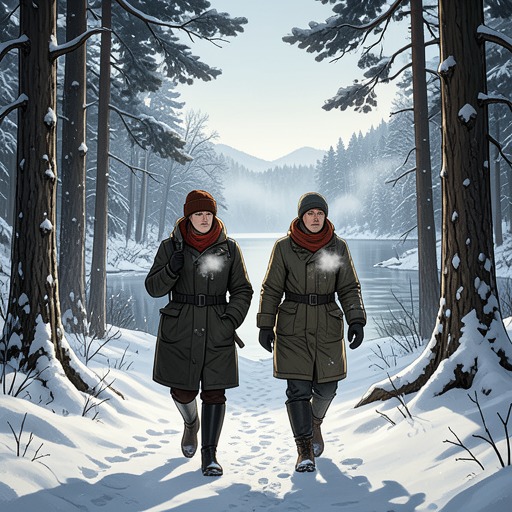
In the second week of February, a blizzard cuts the town’s power for two days and cancels school. The storm offers a welcome break from classes, but its snow lies so deep and the air is so bitter that staying outside for more than five minutes is difficult. Finch counters the cold by telling himself that snow is only water in a different form, then makes the long walk to Violet’s house. There, the pair build the world’s largest snowman, name him Mr. Black, and imagine him as a destination for other wanderers. The snowman turns an obstacle into part of their shared project: even a storm can furnish a place to visit and a reason for others to roam.
After building him, Finch and Violet sit with Violet’s parents around the fire. Finch pretends that he is part of the family. The small scene gives winter a domestic counterpoint to its punishing outdoor conditions. Cold keeps the couple close to shelter, but the fire and the welcome of Violet’s household make that shelter feel like a glimpse of belonging.
Once the roads have cleared, Finch and Violet cautiously drive out to see a series of Indiana sights: the Painted Rainbow Bridge, the Periodic Table Display, the Seven Pillars, and the site where the Reno brothers were lynched and buried. At The Quarry, they climb the high walls of the place from which 18,630 tons of stone were taken to build the Empire State Building. They also visit the Indiana Moon Tree, a sycamore grown from a seed that went to the moon and returned. More than thirty years old, it is one of only fifty living trees from an original five hundred. These outings show the pair resuming their wandering as soon as winter permits, moving between local curiosities, historical traces, and a rare survivor of an ambitious experiment.
Their travels include going to Kokomo to hear the hum in the air and rolling Little Bastard in neutral up Gravity Hill. Finch describes the ride as the world’s slowest roller coaster, an oddity that becomes part of their itinerary because it works. Afterward, he takes Violet to Happy Family, his favorite restaurant, for a Valentine’s Day dinner. The restaurant is about fifteen miles from home, at the end of a strip mall, and Finch prizes its Chinese food. Even in winter, their roaming is not limited to grand or remote destinations: it includes a local acoustic mystery, a strange road, and a familiar meal shared on a holiday.
The First Warm Day
The first warm day arrives on a Saturday and takes Finch and Violet to the Blue Hole, a three-acre lake on private property near Prairieton. They do not need jackets, only sweaters; after the winter they have endured, the weather feels almost tropical. The change is modest in practical terms, but it alters the emotional atmosphere of the outing. For once, cold is not the force dictating how long they can remain outdoors.
Finch brings offerings for the water: the stubs of Violet’s SAT number 2 pencils and four broken guitar strings. He leads her up the embankment and down the hill to a wide, round pool of blue water surrounded by trees. Its privacy and silence let him imagine that the two of them are the only people on earth, a temporary version of the isolation he wishes could be permanent. Violet takes in the place, breathing out as she asks what it is. The scene makes winter’s end feel like an opening into another kind of space, quiet and removed from the town, even though the wish to keep that refuge to themselves remains only a wish.
Winter, Grief, and the Gift of Flowers
Later, winter carries a more unsettled meaning. At a nursery, Finch apologizes for arriving after closing and explains that he wants flowers for his girlfriend. He calls it an emergency, then qualifies the word: winter is here, he does not know where he will be by spring, Violet is named for a flower, and her father hates him. He wants her to know that he is thinking of her and that this is not a season of death but one for living. His appeal links the flowers to several concerns at once: affection for Violet, conflict with her father, uncertainty about his own future, and resistance to winter’s association with death.
When Finch brings the flowers to Violet’s house, the night is freezing and snow has started again. She is wearing pajamas, slippers, and a robe; she notices that he is shivering. Finch says he cannot feel it and cannot remember how long he has been outside. Violet’s eyes are red. The narration connects her tears both to her dislike of winter and, more likely, to the approaching anniversary of the accident. The renewed snowfall therefore arrives not as a simple seasonal detail but alongside a return of grief.
Violet opens the refrigerated shipping bucket and breathes in the flowers’ scent. She kisses Finch without saying anything, then tells him that he has brought her spring. The gesture does not change the weather: it is still snowing, and Finch has been standing in the cold. Instead, it changes what the winter night means between them. His gift answers a season associated with death by offering a sign of life, and Violet receives that intention as a form of warmth. Winter’s role in the story is thus not merely to delay movement or make the characters uncomfortable; it gives their shared shelter, their return to wandering, and Finch’s wish for a living future a concrete seasonal contrast.